
Spanish Fork Police Blotter Records
Spanish Fork Police Blotter records start with the city police records request page and the city records office. That matters because Spanish Fork gives the public a clear route for accident reports, GRAMA requests, and police report copies, but it also sets rules for active cases and third-party requests. If you know the date, report number, or person name, the city can narrow the file fast. If the record moves into Utah County custody or court, the search continues there. The city is the first stop. The county and courts finish the trail.
Spanish Fork Police Blotter Basics
The Spanish Fork Police Department records request page is the cleanest place to begin a Spanish Fork Police Blotter search. The page separates traffic accident reports from police reports and tells you exactly which office to contact. For accident reports, the city says that until December 31, 2025, you go to the Police Department with a case number, accident date, name of the person involved, and driver's license number. In 2026, the same request moves online through CrashDocs, where the report or reference number, last name, and accident date are the main details.
That change matters because it tells you the city wants a direct, documented request, not a broad guess. The page also says most accident reports are available within 5 to 10 days, and if the report is still missing after 10 days you should contact the Spanish Fork Police Department at 801-804-4700. That gives the search a real timeline. It also tells you when the record is probably still moving through the city review process instead of getting lost.
The city records office adds the other piece of the local trail. Spanish Fork lists its records office at 40 S. Main St., Office 130, with office hours Monday through Friday from 8 a.m. to 5 p.m. The contact line is 801-804-4530 and the email is records@spanishfork.gov. That matters for a Spanish Fork Police Blotter request because not every record lives only at the police desk. Sometimes the city records office is the smoother place to start, especially if you need a clear public-record contact instead of a report status question.
Spanish Fork Police Blotter Requests
Spanish Fork's GRAMA page is unusually direct about police report access. The city says you must be the subject of the record or the legal guardian of a minor named in the record. It also says you cannot receive a copy of an active report until the report is cleared and completed. If you are being charged in the case, the city points you to discovery through the Attorney's Office while the case is still active. That is a strong boundary, and it keeps the city report request from turning into a request for an open investigation file.
The same page says a third party must have a signed and notarized release before getting the report for someone else. It also says the request should include photo identification, the date of the incident, a reasonable description of the record, and a case number if one is available. Those details are useful because they tell the records office exactly what to look for. A Spanish Fork Police Blotter request works best when it is narrow enough to match one report and not half a dozen related calls.
Fees are also clear. The city says the standard charge is $10 per report, with higher copy costs for lengthy files, $25 for CD or DVD copies, $2 for colored copies, and $2 for certified copies. The fee is due when you submit the GRAMA request, and you can fax, mail, or bring the request to the Police Department. If you choose fax, the number is 801-804-4740. That is the kind of local detail people need before they file, and it makes the request easier to plan.
The city also says Utah law gives it 10 working days to process a request, or 5 days for an expedited response when the requester can prove the need. That puts a real clock on the request without pretending every file is instant. If the city needs to review the record, that is normal. The goal is to get the right report, not the first report that happens to show up.
Spanish Fork Police Blotter and Utah County
Once a Spanish Fork arrest turns into custody, the Utah County inmate search becomes the next stop. The sheriff's office says booking information appears 24 hours after booking, so the county roster may not show the name right away. That delay is important in a Spanish Fork Police Blotter search because the city call can be logged before the jail record appears. When the county record does appear, it can show the arrest date and time, arresting agency, booking number, status, charges, and release information. That fills in the custody side of the story.
Utah County inmate search is the best county follow-up when a Spanish Fork police call moves from a city report into booking or jail processing.
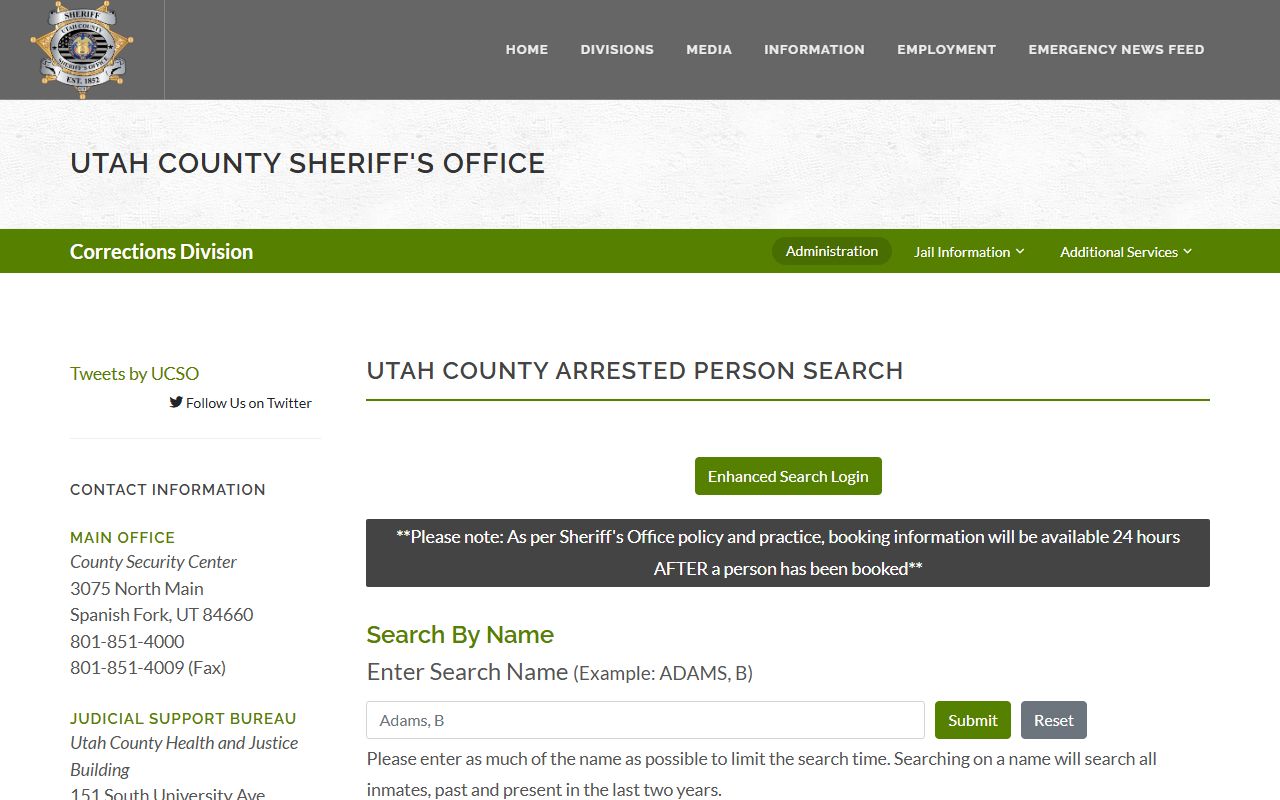
That county roster is especially useful in Spanish Fork because the Utah County Jail and Records Division are also located at 3075 North Main in Spanish Fork. If you need a written request or you want to verify a county record in person, that same address is part of the local records trail. The county warrant search can help too, and the Utah courts records page becomes the next stop when the case has already been filed.
The county context matters because Spanish Fork police records are only one piece of a larger process. A city report tells you what happened. A county roster tells you who was booked. A court file tells you what the system did with the charge. That three-step sequence keeps the search organized and avoids asking the wrong office for the wrong record.
Spanish Fork Police Blotter and GRAMA
GRAMA is the law that controls release, timing, and redaction for Spanish Fork Police Blotter records. The state statute at Utah GRAMA statutes starts with a presumption of access, but it also lets agencies withhold protected or private material when the law requires it. That is why a police report can be public while some witness or investigative details stay back. Spanish Fork follows that same pattern. The city can confirm the record, review it, and release only what is allowed.
The state public records portal at Utah Department of Public Safety public records portal is a good statewide fallback when a Spanish Fork request needs to be compared with a state-level process. It is not the same as a city police request, but it helps explain how Utah public records workflows move when a report leaves the local office. If the question becomes broader than one city file, the Utah Bureau of Criminal Identification and the Utah courts records system are the next state sources to check.
For older Spanish Fork Police Blotter research, the Utah State Archives criminal guide is useful when the record has moved out of the active city workflow and into historical storage. The Utah State Records Committee is the review path when a local response does not settle the access issue. Those state tools are not replacements for the city report, but they are the right backup when the local request hits a boundary. A good search follows the record wherever the record actually lives.
The city and county offices each do a different job. Spanish Fork handles the local request. Utah County handles the custody trail. The courts handle the filed case. When you line those up in order, the police blotter search becomes much easier to read.
Utah County and City Links
Spanish Fork sits in Utah County, so the county page is the next step when the police blotter search moves into booking, warrants, or court records. The nearby city pages help when the incident started just outside Spanish Fork or when another Utah County department handled the first call.
Nearby Utah Cities
Nearby city pages help when the call crossed a line or when a different local department handled the first part of the report. That is common in Utah County, where a Spanish Fork Police Blotter search can overlap with more than one office.