
Search Utah County Police Blotter
Utah County police blotter records are often the fastest way to confirm a recent booking, see which agency made the arrest, or decide whether you need the court file next. The county seat is Provo, but many jail-related searches point to Spanish Fork because that is where the county jail sits. That split matters. One office may show the booking first, another may hold the case file, and a third may manage warrant details. Use this page to move through those steps in order, so you can get from a name to the right record without guessing.
Utah County Quick Facts
Utah County Police Blotter Basics
Utah County Sheriff records are the first stop for most local booking searches. The office provides an Arrested Person Search with enhanced search tools, but the booking information does not appear immediately. The research says it is available 24 hours after booking, which gives staff time to process and verify the record before it is shown to the public. That delay is normal. It keeps a fresh arrest from being mistaken for a finished case.
The search works by name or arrest date. If you know the last name, use that first. If you only know the day, use the date search. The system can show current inmates and also reach back into recent history, which is helpful when a person has moved between jail, monitor status, and release. Utah County also offers inmate statistics and visitation information, so the sheriff site can answer more than one question in one visit.
For people who need a broader public record trail, the county records division is at 3075 North Main Street in Spanish Fork, UT 84660, and the phone number is (801) 851-4000. That matters because a local police blotter search often ends with a request for a copy, a case check, or a follow-up on custody status. The office is set up for that path, not just for a quick web search.
This screenshot from Utah County Sheriff's Office inmate search shows the main online route for recent booking information and custody status.
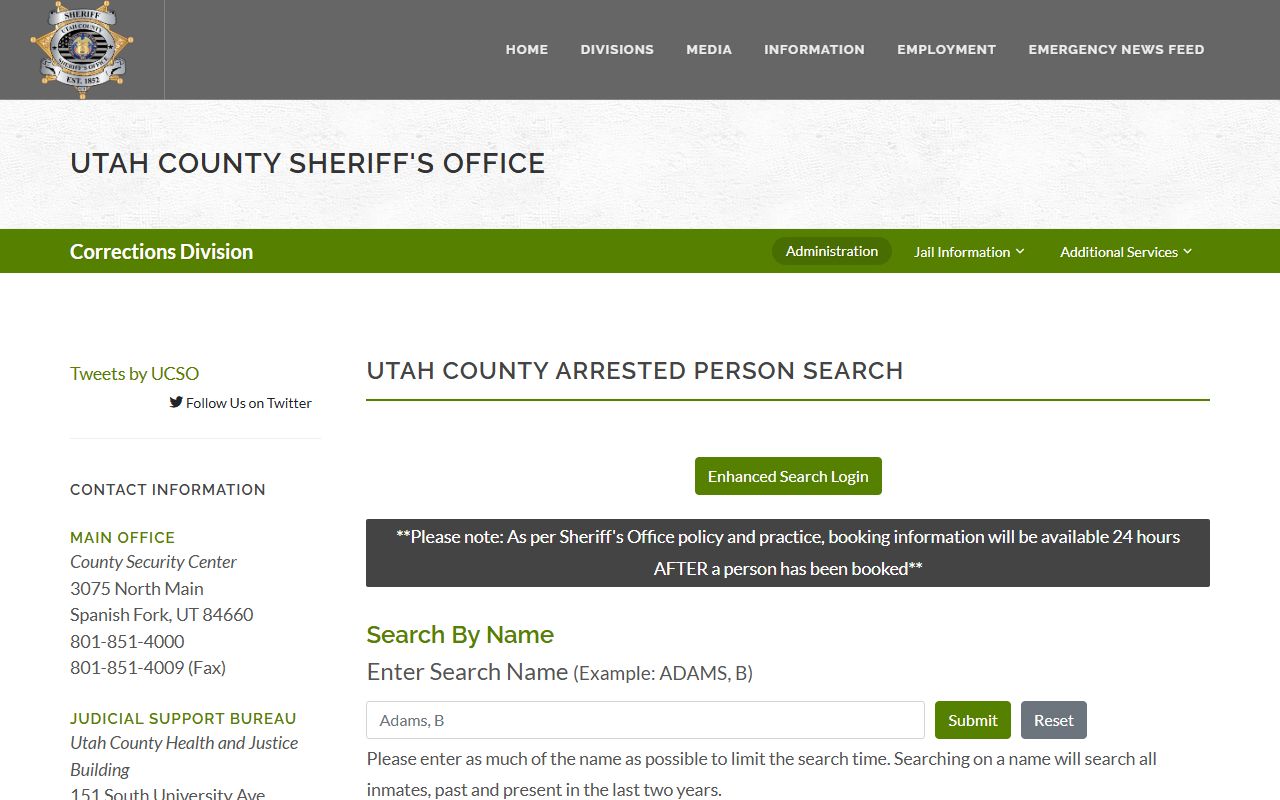
That page is the best first check when you need a recent arrest, a booking number, or the name of the agency tied to the intake.
Utah County Police Blotter Search
When you search Utah County police blotter records, start with the sheriff roster because it can show the arrest date, booking date, booking number, release date if there is one, and the arresting agency. Charges are listed one by one. You can also see whether the person is active, on an electronic monitor, or no longer in the jail. That makes the roster more useful than a one-line arrest note.
The Utah County jail page and the research notes both point to the same basic method. Search by name or by arrest date. The system is free to use, and the county says the roster updates daily, with some updates happening as often as every 15 minutes. That is fast enough for a lot of routine searches. Still, the 24-hour booking delay means a very recent arrest may not yet appear.
For a broader explanation of the public-record side, Utah County's official records division and inmate-search materials explain how arrest records differ from conviction records and why some material stays protected even when the booking is public. The county records division is the place to ask when the online summary is not enough.
This image from Utah County inmate search supports the county search path and shows the next layer after a roster lookup.
Use that official county search path when you want the plain-language route from booking search to a fuller county records request.
Utah County Police Blotter and Warrants
Warrants are a separate but related track in Utah County. The sheriff's office is the main local source, and the research points to a fugitive or extradition page on the sheriff site for active warrant questions. That is important because a warrant search is not the same as a jail roster search. One tells you who is booked. The other tells you who is wanted or still being handled through a warrant process.
Utah County also points users to the Utah Statewide Warrant Search Tool through the Department of Public Safety. That gives you a state layer when the county page is not enough. If unpaid fines are the issue, the research says some people can pay through the sheriff website. If you are trying to locate a case file tied to a warrant, the county GRAMA process is the right next step.
The warrant page also gives direct contact options for the Warrant Department and extraditions. That is useful when an online search gets close but not close enough. In Utah County, a blotter entry, a warrant note, and a court file can all point to the same person, but each source shows a different piece of the record trail.
This image from Utah County inmate search shows the county custody path that sits alongside the booking and court trail.
That official county source is useful when the question is not just who was booked, but how the county side of the record trail fits together.
Utah County Police Blotter and Court Records
Once an arrest becomes a case, the court side matters. Utah County research identifies the Utah County District Court in Provo at 125 North 100 West, Provo, UT 84601, phone (801) 429-1000. That court holds the records tied to prosecution, and the Xchange case search helps you find proceedings after an arrest. It is the right move when the jail summary is no longer enough.
Public access terminals are available at the Utah County Justice Center, so in-person searching is still part of the workflow. That helps if you need a case number, a court date, or a copy of a filed document. The county also points to the Provo Police Department's GRAMA request page, which matters when the arrest started inside city limits and the city police report is the real file you need. Provo police records include incident reports, arrest reports, accident reports, and body camera footage subject to restrictions.
Utah County also notes that arrest records and conviction records are different. A police blotter entry shows suspicion or intake. A court case shows what happened after that. If you want the full chain, you usually need both.
This image from Utah Department of Public Safety public records portal shows a state-level GRAMA route that can matter when a Utah County search needs more than the jail roster.

Use that state path when a local record turns into a formal request for a DPS-related file or when a county response points you to another office.
Utah County Police Blotter Records
Utah County records follow GRAMA, which means the default rule favors access but still allows redaction and withholding when the law requires it. The research cites Utah Code § 63G-2 and also Utah Code § 53-10-108 for criminal history record information. That is the legal line between a public booking summary and a more controlled criminal history file. Ongoing investigations, juvenile information, and private or protected details can be kept back.
The county records division can still help you move forward. If you need the file itself, bring enough identifying detail to make the search efficient. Full name, date of birth, and arrest date are the best starting points. When you have a booking number, use it. That reduces the chance of a mismatch and speeds the review. Fees may apply for retrieval and copying, so it helps to ask before you file.
For state-level criminal history, the Utah Bureau of Criminal Identification is the better fit. The county roster is not the same thing. BCI keeps the official criminal history repository, while the sheriff keeps local custody and booking data. Keeping those roles separate saves time and keeps the request pointed at the right office.
Get Utah County Copies
If you need copies from Utah County, start with the office that actually holds the record. The sheriff handles bookings, custody, and the inmate search path. The court handles filed cases. Provo police handle local police reports that start inside the city. That division matters because copy requests are easier when you send them to the correct desk the first time.
Utah County allows in-person, written, and electronic requests. The research says the sheriff office uses a GRAMA form, government photo ID, and payment for applicable fees. Written requests should include the record description, contact information, and any case number you know. That is standard, but it works. It keeps the county from guessing which person or event you mean.
Note: Utah County police blotter records can tell you who was booked, but the court file and the records division usually tell you what happened next.
For a state follow-up, the Utah Department of Corrections search and Vinelink can help if the person moved out of county custody and into state supervision.
Nearby County Records
Utah County searches often cross into nearby counties when a person was arrested elsewhere, transferred, or charged in a different court. These links help keep the search moving.