
Search Daggett County Police Blotter
Daggett County police blotter records can be hard to read if you do not already know which office holds the next step. Daggett is Utah's least populous county, and its sheriff's office serves a wide area around Manila, Flaming Gorge, and the mountain roads that connect the county to the rest of northeastern Utah. That means a search may begin with a booking note, move to a justice court file, and end with a transport record in another county. Start with the sheriff, then check the court, then use state tools when the local trail runs thin.
Daggett County Quick Facts
Daggett County Police Blotter Basics
Daggett County police blotter work starts with the sheriff's office. The county site says the office handles patrol, investigations, search and rescue, and civil process. That makes it the first contact for a recent stop, a boating enforcement matter, or a rural call that ended in custody. Because the county does not run a full-service jail, the booking side of a search may point you to Uintah County Jail or another regional facility. That is common here, and it is one reason a Daggett County police blotter search often needs more than one office.
The county sheriff also coordinates with the Daggett County Justice Court for warrants and court security. Court records are kept in Manila, so the court file may be closer to the event than the jail. If the matter involved a misdemeanor or ordinance violation, the justice court can be the record that tells you what happened after the stop. That court-side step matters because a blotter entry usually gives only the first line of the story.
For a local starting point, the Daggett County Sheriff's Office page at daggettcounty.org/sheriff is the official county source for patrol, civil process, and records contact details. It is also the place to confirm where the county wants a GRAMA request sent. In a county this small, a direct contact can save a lot of time.
This county page on the sheriff's office at daggettcounty.org/sheriff is the local source behind the Daggett County police blotter search path.
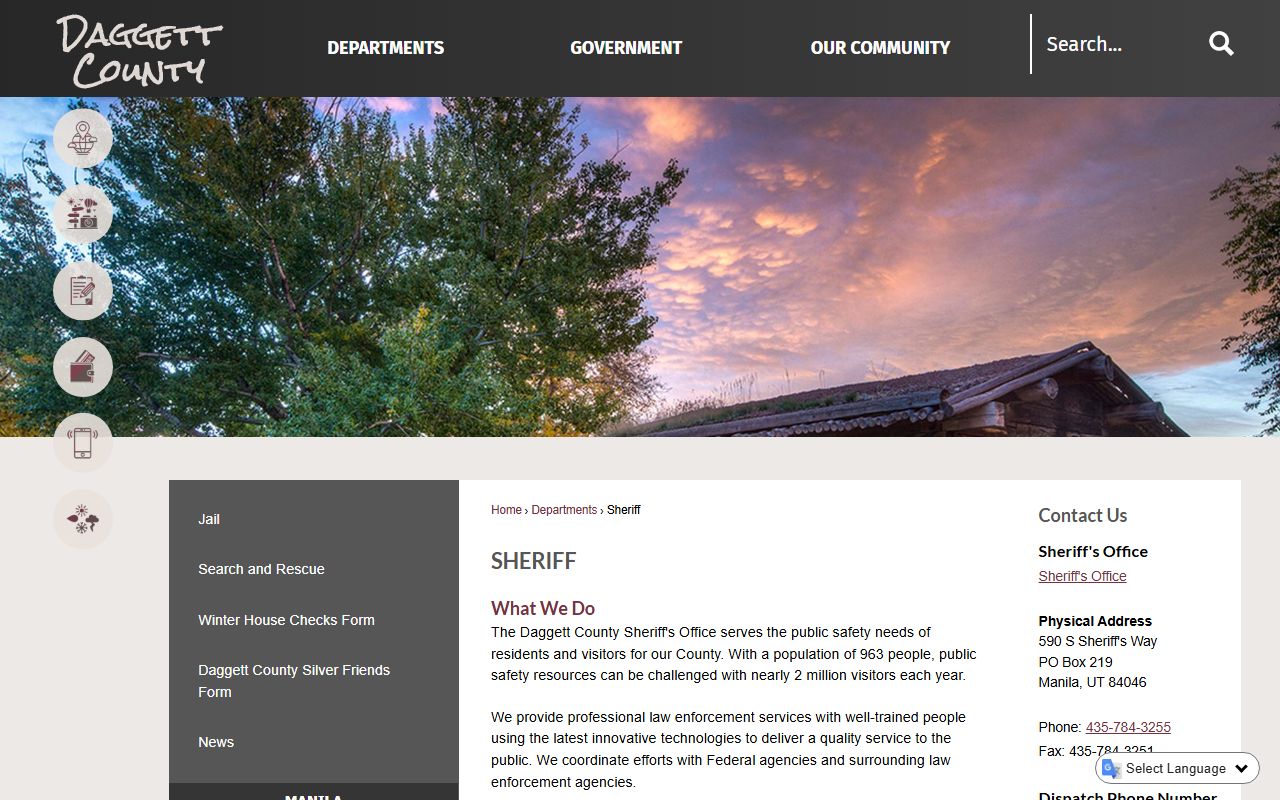
The image shows the county source you use first. It anchors the search in the right office before you move to court or a regional jail.
Daggett County Police Blotter Search
The fastest Daggett County police blotter search is usually a direct call or written request to the sheriff. The office handles records requests under GRAMA, and the research says requests may be submitted in person or by mail. That fits the county well, because the office covers patrol, search and rescue, boating enforcement, and civil process in a place where incidents are often spread out over a long distance. A name and a date are often enough to get started.
Since Daggett County does not keep a full jail, a booking search may require checking transport records or a neighboring county facility. The county research says arrestees are typically housed in Uintah County Jail or another regional facility. That detail matters because the county blotter alone may not show where the person ended up. If you only check the local page, you may miss the custody side of the record entirely.
The sheriff also patrols Flaming Gorge Reservoir, and boating enforcement may create incident reports that look different from a normal street arrest. Those reports can still fall under the same records process. When the stop happened on the water or in a remote part of the county, the office that logged the incident may be the only one that can tell you where the paper trail went next.
For a second local route, the official county sheriff page at daggettcounty.org/sheriff is the best source for records contact and county service details.
Daggett County Police Blotter and Court Records
Daggett County court records matter because the justice court handles the misdemeanor and ordinance side of the county record chain. A police blotter can show that a person was stopped, booked, or cited. The court file shows what happened after that. In a small county, that distinction is important because the justice court may be the only local office with a clean view of the case outcome.
The county research says the justice court is located in Manila. That makes the court a useful next stop for warrant service questions, court security issues, and case documents tied to the arrest. If you need the case number, hearing date, or final result, the court file is the better source than the blotter. If the person was transported out of county for custody, the local court file can still show the charge history even if the jail is elsewhere.
For statewide court access, Utah courts remain a useful backup. The records portal at utcourts.gov/records helps when a local Daggett County search turns into a broader case lookup. If the matter is older or the local file is thin, the state route can confirm whether the charge reached court and where the file lives now.
Daggett County Public Records
Daggett County follows GRAMA, so the default rule is access unless a record is classified as protected or private. Under Utah Code Title 63G Chapter 2, the county must respond to written requests within ten business days, with a five business day path for some expedited requests. That timing does not mean every record is immediate. It does mean the county must answer and explain if it needs more time.
Public access works best when the request is narrow. Ask for the report type, the date range, the name, and any case number you have. If the request is about boating enforcement, search and rescue, or civil process, say that up front. Those records can be different from a simple arrest log, and the county can route them more cleanly if you are specific from the start.
Some details may be withheld if release would interfere with an investigation or expose sensitive information. That is normal in Utah police blotter work. The public log may still exist even when the full report is not ready. If the county denies part of a request, the reason should be tied to the law and not just to convenience.
Note: Daggett County police blotter records often sit across the sheriff, the justice court, and a regional jail, so one search step is rarely enough.
Daggett County State Records
State tools help when the local trail is thin. The Utah Bureau of Criminal Identification gives the broader criminal history path, and the Utah Department of Public Safety offers a public records portal for state-level requests. Those tools are not the same thing as a Daggett County blotter, but they can confirm whether a local arrest turned into a state custody or state records issue. That is useful in a county where arrestees are often transported elsewhere for housing.
The state BCI page at bci.utah.gov/criminal-records is the right backup when you need an official criminal history route. For broader records requests, the DPS portal at publicsafety.utah.gov can help when the record came from a state law enforcement office rather than the county sheriff. Historical records research can also move into the Utah State Archives when the matter is older than the local files.
Daggett County Copies
If you need copies, start with the office that created the record. The sheriff handles the incident side, the justice court handles the case side, and the regional jail handles custody information. That separation matters in Daggett County because the county does not house every arrest locally. A request sent to the wrong office may still be valid, but it will move slower.
Bring the name, date of birth if you have it, and the approximate date of the event. If you are asking about boating enforcement, search and rescue, or civil process, include that detail too. The sheriff's office can then route the request without guessing. If the matter moved to court, the clerk may be able to point you to the document you actually need.
Daggett County works best when the search stays narrow and local. Start with the sheriff, verify the court, and then use state tools only if the county file does not answer the question.
Daggett County police blotter searches are most reliable when the sheriff's office and the justice court are treated as separate record sources.
Nearby County Records
Daggett County is small enough that nearby counties matter. If a booking was transported, or if a charge moved into a regional custody facility, a neighboring county page may show the next clue. The county line is not always the record line.